Gorbachev’s nuclear disarmament strategy (Part 1)
- Sean Fitzpatrick

- Feb 20, 2020
- 6 min read
Updated: Feb 26, 2020
Gorbachev had many strategic successes during his time in power, but I believe that his greatest success was how he handled the Cold War between the Soviet Union and the US and halted their nuclear arms race before nuclear warfare took place. This event saw these two global superpowers at the brink of nuclear war which would result in the destruction of both nations. Gorbachev’s most successful act while in power was his strategic management of this crisis and his ability to convince both nations to engage in nuclear disarmament, reducing the risk of this crisis ever occurring again. However, the work that Gorbachev made to avoid nuclear proliferation and nuclear conflict is now under threat. The threat of nuclear war is at its highest point since the cold war. More and more countries have been gaining access to nuclear weapons and the disarmament treaties that Gorbachev help create are being torn up. The world may be entering its second cold war and it’s not certain that this one will also be peacefully averted. It is because of this that is now, more important than ever that our world leaders’ study how Gorbachev’s successfully disarmed the USSR’s and US’s nuclear arsenals and use this strategy to avoid today's crisis. In this post I will analyse Gorbachev’s nuclear disarmament strategy and discuss the effects it had in averting nuclear war. Stay tuned for next week’s post. In part 2 I will explore the current tensions between today's nuclear superpowers and how they can use Gorbachev’s strategy along with new information systems to ease these tensions and aid in the goal of complete nuclear disarmament.
Background
The risk of nuclear war began with the creation of the first weapons of mass destruction. The first nuclear weapons were created by the US during World War II. This research (known as the Manhattan Project) was led by the US but included assistance from the other Axis powers. This project resulted in the first ever nuclear weapon being detonated on the 16th of July 1945. This explosion was conducted during the “Trinity test” in at New Mexico's Alamogordo Bombing and Gunnery Range. The scientists who created this weapon, were astonished by its strength and the risk that it posed for global destruction. On sight of this explosion, lead scientist Robert Oppenheimer describe the power of this bomb using a quote from the Hindu scripture, the Bhagavad-Gita (TEMPERTON, 2017).
“Now I am become Death, the destroyer of worlds” (Robert Oppenheimer, 1945)

Figure 1: A photograph on display at The Bradbury Science Museum shows the first thermonuclear test (Bradbury Science Museum)
Word of the completion of this weapon was announced to the Soviet Union and in response the Soviets too began to develop their own nuclear weapons. It wasn’t long after the completion of this weapon, that the US used them against their enemies. In August of 1945 under the instructions of US president Harry Truman, two nuclear weapons were dropped over Japan, one in Hiroshima, and the second in Nagasaki. The explosion of these bombs and the resulting radiation fallout killed approximately 135,000 people in Hiroshima and 75,000 in Nagasaki and left both cities in ashes. While these bombings were a key factor in ending World War II with the Japanese surrendering days after this attack, it remains a constant stain on the history of humanity and a record of only a fraction of the possible destruction that these weapons offer.

Figure 2: Hiroshima Red Cross Hospital in ruins (October 6, 1945) (Hiroshima Peace Media Center, n.d.)

Figure 3: 22-year old victim Toyoko Kugata being treated at the Hiroshima Red Cross Hospital (October 6, 1945) (Hiroshima Peace Media Center, n.d.)
After seeing the destruction that these weapons were capable of, the Soviets were encouraged to hasten the development of their own in order to deter any future nuclear attacks against them. In August 1949 the development of their first nuclear weapon was complete. The US no longer had exclusive access to the powers of nuclear weapons. By both superpowers having their own weapons, it acted as a deterrent from either using them as any nuclear attack from one would result in an equal response creating mutually ensured destruction. Both powers continued to increase their stockpiles of nuclear weapons in the following years and continued to improve on the destructive capabilities of these weapons. The US detonated their first hydrogen bomb in 1952 which is capable of being 1,000 times more powerful that the traditional atomic bomb that than was dropped over Hiroshima and Nagasaki (CHAN, 2017). It was now clear that these weapons represented an existential risk for humanity.
Cold War
This nuclear proliferation continued and the tensions between these powers grew stronger. These tensions reached a breaking point during the Cuban Missile Crisis. In 1962 a US spy plane discovered that the soviets had placed nuclear weapons in Cuba. This represented an extreme risk for US safety as this missile had the ability to strike the US with little warning. In response to this discovery US president John F Kennedy created a naval blockade around Cuba. These tensions resulted in the US military moving to DEFCOM 3 and later 2, which marked the closest that the US has ever been to full nuclear war.
However, this crisis was able to be averted due to the diplomatic negotiations that took place behind the scenes from the public. In was agreed that the Soviets would remove the missiles from Cuba and in response the US would remove the missiles from Turkey that were in striking distance to the USSR. This alleviated the tensions between the two powers and the risk of nuclear war was averted.
Gorbachev’s Disarmament Strategy
After this incident and the continuing stockpiling of nuclear weapons, it was clear that urgent actions were needed to end this arms race before tensions rose again. Soon after this incident, when Gorbachev gained control over the Soviet Union, one of his main priorities was slowing the arms race that they and the US were engaged in. To achieve this goal, Gorbachev deviated from the traditional nuclear strategies that were practiced by his predecessors. His predecessors’ strategies involved creating an illusion of safety for their people by creating even stronger weapons in larger quantities to act as a deterrent to their enemies due to the response that they were capable of. However, Gorbachev saw that this strategy was flawed. The creation of even stronger weapons would only motivate their enemies who were following a similar strategy to also invest in even stronger weapons to gain the upper hand. This cycle would continue, while making their nuclear armouries more difficult to manage and increasing tensions between other nuclear powers. Instead of continuing this strategy of threats and displays of power Gorbachev adopted a strategy that involved trust and creating a close relationship with other nations. Gorbachev established a close relationship with US present Reagan and negotiated a disarmament strategy with him, rather than negotiating through threats as his predecessors did. This was an effective strategy as soon after him and President Reagan signed the Strategic Arms Reduction Treaty which committed both powers to reducing their stockpiles of missiles.
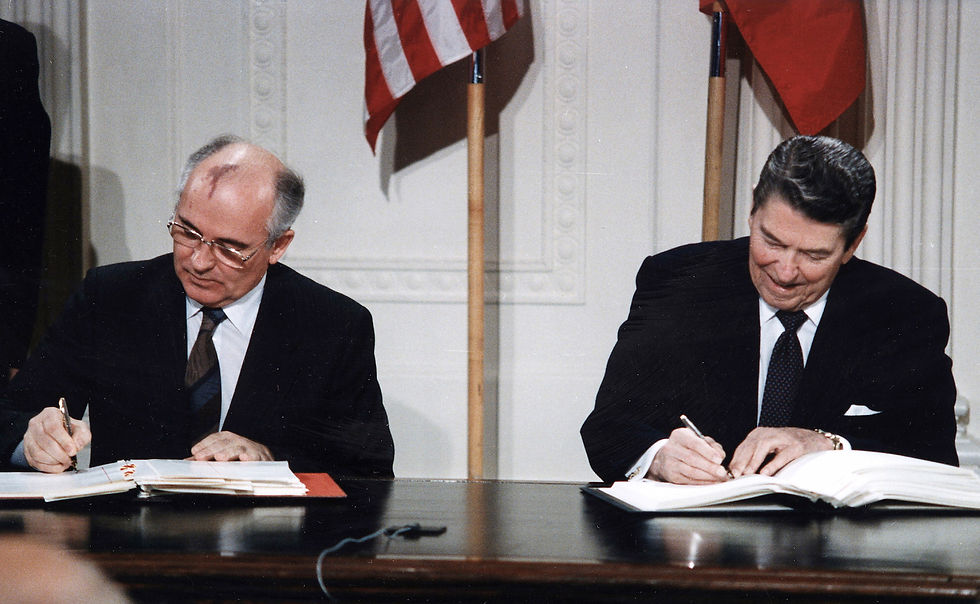
Figure 4: Mikhail Gorbachev signing nuclear disarmament treaty
This agreement was very successful as it saw both powers disarming the large majority of their nuclear weapons, leaving each power with less than 5,000 each in 2010 (Figure 5). These results display the clear success that Gorbachev’s strategy had for the goal of nuclear disarmament

Figure 5: Number of warheads owned by the USSR and US
(Graph from Wikipedia (Wikipedia, n.d.), Data from (Kristensen, 2006))
In the address given by Gorbachev to the Council of Europe in 1989, he claimed that (Parliamentary Assembly, n.d.).
“No doubt, joint Soviet-US efforts in the area of nuclear disarmament played a major starting role in the process” (Gorbachev, 1989)
The results of Gorbachev’s nuclear disarmament strategy were a resounding success. He helped to bring the world into a new era of peace with his actions. However recently tensions between today's nuclear powers have increased and many of the treaties the Gorbachev help to make are being torn up. Be sure to check in next week to read more about how Gorbachev’s strategy and new information systems can be used to ease today's nuclear tensions.
References
CHAN, M., 2017. What Is the Difference Between a Hydrogen Bomb and an Atomic Bomb?. [Online] Available at: https://time.com/4954082/hydrogen-bomb-atomic-bomb/ [Accessed 7 2 2020].
Hiroshima Peace Media Center, n.d. The A-bomb Photographs of Shunkichi Kikuchi, Part Ⅱ: Images from Hiroshima Red Cross Hospital. [Online] Available at: http://www.hiroshimapeacemedia.jp/?gallery=2008070420280041_en [Accessed 8 2 2020].
Kristensen, R. S. N. a. H. M., 2006. Global nuclear stockpiles, 1945-2006,, s.l.: Bulletin of the Atomic Scientists.
Mosher, D., 2020. Trump's unpredictability is making nuclear-nonproliferation advocates nervous as the US takes an aggressive posture against Iran. [Online] Available at: https://www.businessinsider.com/trump-iran-attack-tactical-nuclear-weapons-war-consequences-2020-1?r=US&IR=T [Accessed 7 2 2020].
Parliamentary Assembly, n.d. MIKHAIL GORBATCHEV PRESIDENT OF THE SUPREME SOVIET OF THE SOVIET UNION SPEECH MADE TO THE ASSEMBLY THURSDAY, 6 JULY 1989. [Online] Available at: http://www.assembly.coe.int/nw/xml/Speeches/Speech-XML2HTML-EN.asp?SpeechID=78 [Accessed 8 2 2020].
TEMPERTON, J., 2017. 'Now I am become Death, the destroyer of worlds'. The story of Oppenheimer's infamous quote. [Online] Available at: https://www.wired.co.uk/article/manhattan-project-robert-oppenheimer [Accessed 7 2 2020].
Wikipedia, n.d. Nuclear arms race. [Online] Available at: https://en.wikipedia.org/wiki/Nuclear_arms_race [Accessed 8 2 2020].


So shocking to read about the devastation caused by Nuclear war and how much it took for the world to realise the effects it could have on us all. Great read.